
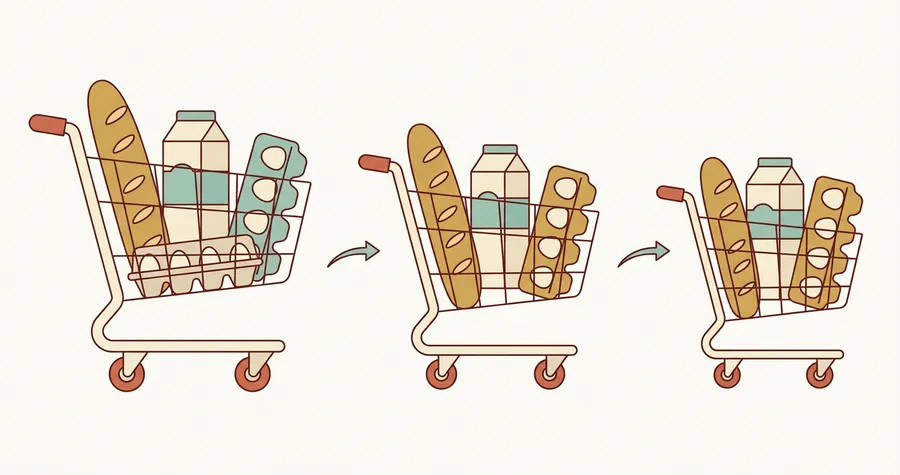
In October 2022, Giorgio went to buy the same weekly grocery shop his wife had done for twenty years. Same list, same supermarket, same brands. The bill was €107. A year earlier the same shop had cost €88. Nobody had told him anything was changing. The numbers just were different.
That’s inflation. Today’s lesson explains exactly what the word means, how it’s measured, why it happens, and what it does to the money you have sitting in a bank account.
What inflation actually is
Inflation is a general, sustained increase in the price level of an economy. Not “this one thing got expensive” — that’s a relative price change. Inflation means most things got more expensive relative to money. Equivalently: money became worth less relative to stuff.
The inverse, deflation, is a general fall in prices. Sounds nice but is usually catastrophic — we’ll explain why later.
Two things go up in an inflationary environment:
- The price of goods and services (you pay more euros for the same bread).
- Wages, eventually (you earn more euros for the same work).
Critical word: “eventually.” Prices adjust quickly. Wages adjust slowly, often a year or more behind. That lag is where inflation hurts people who live on salaries — in the window between price increases and wage increases, your real purchasing power falls.
How inflation is measured in Italy
ISTAT publishes two main inflation measures:
- NIC — Indice nazionale dei prezzi al consumo per l’intera collettività. The Italian national index. Used in domestic contracts (rent adjustment, for example).
- IPCA — Indice dei prezzi al consumo armonizzato (HICP). The eurozone-harmonized index, comparable across EU countries. Used by the ECB for its 2% target.
Both track the same concept: a weighted basket of goods and services households buy. Monthly price collection in hundreds of Italian Comuni, for tens of thousands of items. ISTAT workers physically visit shops or scrape websites to record prices, then aggregate.
The basket includes (weights approximate for 2024, source: ISTAT, Paniere NIC 2024):
| Category | Weight |
|---|---|
| Food and non-alcoholic beverages | ~20% |
| Housing, water, electricity, gas | ~11% |
| Transport | ~14% |
| Restaurants and hotels | ~10% |
| Recreation and culture | ~8% |
| Clothing and footwear | ~7% |
| Furnishings and household goods | ~6% |
| Health | ~9% |
| Education | ~1% |
| Communications | ~2% |
| Alcohol and tobacco | ~4% |
| Other | ~8% |
Your personal basket likely differs from this average. If you don’t own a car, transport matters less. If you rent in Milan, housing matters much more. ISTAT weights reflect the average household, which is a useful proxy for the economy but may not match you. If you want your “personal inflation”, track your actual monthly spend by category for a year.
Causes of inflation
Three main mechanisms, often overlapping:
1. Demand-pull inflation
Too much money chasing too few goods. Happens when:
- The economy is near full capacity.
- Central banks have kept money cheap.
- Government spending is elevated.
- Consumers unlock pent-up demand (e.g., post-2020).
The 2021-2022 inflation had big demand-pull components: COVID savings + fiscal stimulus + reopening all hit supply chains simultaneously.
2. Cost-push inflation
Production costs rise and producers pass them on. Main triggers:
- Energy prices (oil shocks 1973, 1979, 2022).
- Supply chain disruptions (2020-2022 chips and shipping).
- Wage growth outpacing productivity.
- New regulations or tariffs.
The 2022 eurozone inflation was heavily cost-push. Russia’s invasion of Ukraine drove natural gas prices up 500% at peak. Energy-intensive production (fertilizer, steel, aluminum) became more expensive. Those costs rippled through every downstream product.
3. Built-in / expectations-driven inflation
Once people expect prices to keep rising, they act as if they will:
- Workers demand higher wages in advance.
- Firms raise prices preemptively.
- Long-term contracts include inflation escalators.
Inflation expectations become self-fulfilling. This is why central banks work so hard to keep expectations “anchored” at 2%. If the public stops believing the ECB can hold the line, inflation can spiral, as happened in the 1970s.
The 2% target explained
The ECB targets 2% HICP inflation over the medium term, symmetric. Why this specific number?
- Zero would be dangerous. Measurement errors in the CPI mean actual price change is probably slightly below the recorded number. Aim for 0% and you risk actual deflation. Deflation discourages spending (“wait to buy, it’ll be cheaper”), crushes debtors, and is very hard to escape (Japan 1990-2010).
- Higher than 2% erodes purchasing power faster. At 4% sustained, €100 today becomes €67 in 10 years. At 2%, €100 becomes €82. The buffer matters but not too much.
- 2% gives room to cut rates in a crisis. With 2% inflation and a normal interest rate of ~4%, central banks have room to cut aggressively if needed. At 0% inflation and 0% rates, they don’t.
“Symmetric” means the ECB aims to avoid undershooting as much as overshooting. If inflation runs 1% for a while, they’re willing to tolerate 3% later to average out to 2%. This was clarified in the 2021 strategy review.
Real vs nominal
The single most important concept in financial lessons after this one:
- Nominal = the actual number of euros, not adjusted.
- Real = adjusted for inflation, in “today’s purchasing power.”
A conto deposito paying 3% nominal interest, when inflation is 5%, gives you −2% real return. You have 3% more euros but they buy 2% less stuff. The bank account is silently losing.
This is why Sofia’s €12,000 sitting in a conto corrente at 0% is a slow-motion loss. At 3% inflation, her €12,000 today buys what €11,640 bought a year ago. After 10 years at 3% inflation, it buys what €8,900 bought today. Without doing anything “wrong,” she lost €3,100 of purchasing power simply by leaving money idle.
Historical inflation in Italy
Italian CPI year-over-year (source: ISTAT, Indice nazionale dei prezzi al consumo, retrieved 2025-02):
| Year | NIC inflation |
|---|---|
| 1975 | 17.0% (peak of 1970s shock) |
| 1985 | 9.2% |
| 1995 | 5.4% |
| 2005 | 1.9% |
| 2015 | 0.1% |
| 2020 | −0.2% (pandemic-driven) |
| 2021 | 1.9% |
| 2022 | 8.1% |
| 2023 | 5.7% |
| 2024 | ~1% (cooled significantly) |
Pattern: high and variable in the 1970s-80s, the euro era from 1999 brought relative stability around 2%, then COVID + energy + war gave us a 40-year high in 2022.
Giorgio lived through the 1970s inflation as a teenager. He remembers his father’s salary not keeping up; the family tightened for years. He knows 2022 was mild by comparison. Sofia, born in the 1996, had only ever known stable prices until 2022. Her generation’s first inflation lesson was painful.
What inflation does to your money
Four things:
1. Erodes cash and low-yield savings
Cash, conto corrente, conto deposito at sub-inflation yields — all losing purchasing power. At 5% inflation, €10,000 in a conto corrente paying 0.0% becomes €9,524 in real terms after one year. After five years, €7,835.
2. Helps borrowers, hurts lenders
Inflation reduces the real value of debt. If you borrowed €200,000 for a mutuo fixed at 2% and then inflation runs at 5%, the real interest rate is negative. You’re paying back the bank with euros worth less than the ones you borrowed.
This is why fixed-rate mortgages are attractive when inflation is rising. Giorgio’s 2021 refinance at 1.3% fixed turned out to be an excellent trade — by 2022 his real rate was deeply negative.
3. Is partly transparent, partly hidden in investments
- Stocks generally keep up with inflation over long periods. Companies raise prices, revenues rise, nominal earnings rise. But in the short term stocks can fall when inflation rises sharply (2022 was a bad year for both).
- Bonds suffer when inflation rises unexpectedly. Existing low-coupon bonds become less attractive compared to new ones. Bond prices fall. Holding a 10-year BTP at 2% during 5% inflation is losing real value until maturity.
- Inflation-linked bonds (BTP Italia, BTP Indicizzati) are designed to keep up. Their coupons and principal adjust to inflation. Niche but useful as part of a portfolio.
- Real assets (real estate, commodities, infrastructure) often correlate with inflation. Not a perfect hedge, but directionally helpful.
4. Changes tax calculations
Italy taxes nominal gains. If your investment grew 5% nominally but inflation was 5%, your real return is 0% — but you still pay 26% capital gains tax on the 5% nominal gain. Tax is charged in a world where inflation doesn’t officially exist for the tax code.
This is quietly one of the biggest hidden tax effects. Over decades, it compounds meaningfully.
The practical playbook
Concrete actions inflation-aware personal finance:
- Never hold more than 3-6 months of expenses in idle cash. Emergency fund yes (lesson 9), but the rest loses to inflation.
- Use
conto depositofor short-term parking, ETF money-market funds or BTP Italia for medium-term. Match your time horizon to the instrument. - Think real, not nominal. “My pension is €1,500/month” — but in what-year euros? Use real-terms planning.
- For debt, prefer fixed rates when inflation is rising. Variable-rate debt compounds the pain.
- Include some real-asset or inflation-linked exposure in long-term portfolios. Not required if your equity allocation is already high, but useful for conservative investors.
What to do with this lesson
Three habits:
- Track your personal inflation once a year. Your ISTAT-basket inflation and your personal inflation can diverge meaningfully depending on your lifestyle.
- Set a “cash ceiling” rule. Write down how much idle cash you’re willing to hold. Over that, invest — even in something conservative like BTP or a money-market ETF.
- Read interest rates in real terms. A 4% conto deposito when inflation is 6% is not a win. A 2% BTP when inflation is 1% is not a loss. Always subtract.
Sources
- ISTAT — Indice nazionale dei prezzi al consumo.
https://www.istat.it/it/dati-analisi-e-prodotti/prezzi(retrieved 2025-02). - ISTAT — Paniere 2024.
https://www.istat.it/it/archivio/285681(retrieved 2025-02). - ECB — Monetary policy strategy review, 2021.
https://www.ecb.europa.eu/home/search/review/html/index.en.html(retrieved 2025-02). - Eurostat — HICP database.
https://ec.europa.eu/eurostat/web/hicp(retrieved 2025-02). - Banca d’Italia — Bollettino economico.
https://www.bancaditalia.it/pubblicazioni/bollettino-economico/(retrieved 2025-02).
Next lesson: recessions and business cycles — why economies contract, what Italy’s looked like through 2008, 2011, and 2020, and why timing the cycle is almost always a losing strategy.